Building the ranch · Chapter two
We planned two weeks for infrastructure. It took four months.
Before we could build the parts of West End Ranch people might someday come to see, we had to build the systems most people would never notice.
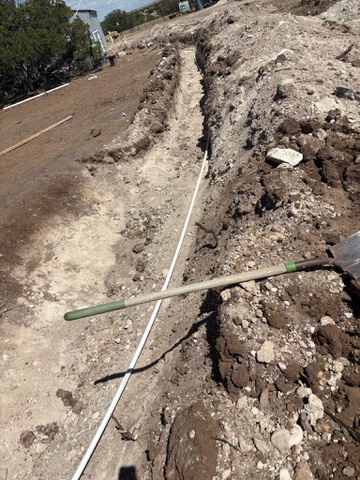
Water lines. Power lines. Trenches. Connections. A solar shade structure. The basic systems that make everything else possible.
We expected that work to take about two weeks.
It took closer to four months—and cost almost twice what we had budgeted.
That difference between the plan and reality became one of our first real lessons about developing raw land in northeastern Arizona. On paper, infrastructure can look like a short list of projects. On the ground, every item on that list is connected to another decision, another measurement, another material, and often another problem you did not know you needed to solve.
Raw land makes you start at the beginning
When people picture building on raw land, they often picture the finished things first.
They imagine a home, a barn, a garden, a campground, or a place where family and friends can gather. Those are the parts that make the dream feel real.
But raw land does not let you begin with the dream.
It makes you begin with access, water, power, drainage, distance, weather, and the question that follows nearly every early decision:
What has to happen before this can happen?
At West End Ranch, we could not simply decide where we wanted something and start building it. We had to think about how water would reach it, where the power would come from, how far the lines needed to travel, and what other projects might eventually depend on the same route.
Every choice had consequences beyond the project directly in front of us.
We understood that infrastructure would require work. What we did not fully understand was how quickly a seemingly straightforward project could expand.
Hundreds of feet looks different from inside a trench
A line drawn on a property plan is clean and simple.
Walking that same distance across open land is different. Digging it is different again.
Our water and power infrastructure required hundreds of feet of trenching. That meant more than opening the ground and laying lines. The routes had to make sense for what we needed now while also supporting what we hope to build later.
There were distances to measure, materials to calculate, elevations and terrain to consider, and decisions about where future projects might be located. We were trying to avoid creating today’s solution in a place that would become tomorrow’s obstacle.
Then there was the physical reality of the work itself.
Trenching across raw high-desert ground is slow, repetitive work. Progress can look impressive from a distance, but when you are standing beside hundreds of feet that still need attention, the scale feels very different.
A task that sounds simple when described in one sentence can consume entire days.
We were not only installing lines. We were beginning to understand the property in a way we could not have learned from a map.
The solar shade became part of the foundation
Power was another project that sounded more contained when it was still in the planning stage.
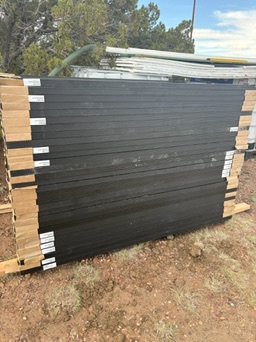
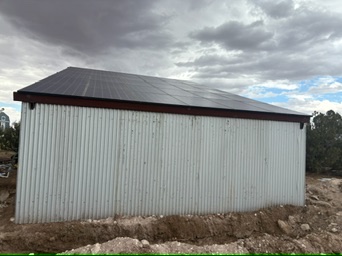
We knew solar would be an important part of building the ranch. Creating the solar shade structure for the power system seemed like one defined piece of the larger infrastructure plan.
But even a defined project has dependencies.
The structure needed to be considered alongside the power lines, the locations those lines needed to serve, and the future use of the surrounding space. We were not placing a temporary object on the land. We were building something that needed to function as part of a larger system.
That required more thought, more coordination, and more time than we originally allowed.
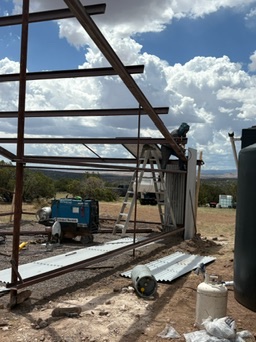
The solar shade was not simply another item to check off a list. It was part of the foundation for the work that would follow.
That became a recurring theme throughout the infrastructure phase: the things we were building first would quietly determine what became possible later.
How two weeks became four months
Our original two-week estimate was not based on believing the work would be effortless. We knew it would be physical. We knew there would be long days. We knew raw land would require us to solve problems as we went.
What we underestimated was how many small decisions lived inside each large project.
We underestimated the time required to move between stages. We underestimated how often one part of the work would need to wait for another. We underestimated how much planning was necessary to make sure that today’s trench, connection, or structure would still make sense as the ranch developed.
Most of all, we underestimated how much the land itself would teach us once we began disturbing the ground and putting the plan into practice.
There is a big difference between knowing where something should go and learning what it takes to get it there.
The timeline did not suddenly jump from two weeks to four months because of one dramatic failure. It stretched through a series of adjustments, added tasks, changed assumptions, and ordinary complications.
That is often how projects grow.
Not through one enormous mistake, but through dozens of reasonable decisions that each require a little more time and money than expected.
The budget changed with the timeline
The longer timeline and the higher cost were connected.
More work meant more materials, more equipment time, more problem-solving, and more expenses that had not appeared clearly in the original estimate. Some costs were easy to anticipate. Others only became visible once the project was underway.
By the time the basic infrastructure phase was complete, we had spent almost twice what we originally budgeted.
That was difficult to accept.
A budget is not just a collection of numbers. It represents the other plans attached to that money—the next improvement, the next structure, or the amount of breathing room you believed you would have after a project was finished.
When one phase costs twice as much as expected, it does not affect only that phase. It changes the timing of everything that comes after it.
We had to adjust.
We reconsidered priorities, accepted that some projects would wait, and became more cautious about treating an early estimate as a complete picture.
The lesson was not that budgeting is pointless. The lesson was that raw-land infrastructure needs a much larger margin for uncertainty than we initially gave it.
What we would do differently
If we were beginning this phase again, we would still build the infrastructure first. There is no useful shortcut around water and power.
But we would approach the schedule and budget differently.
We would assume that every major task contains smaller tasks we cannot see yet. We would build more room into the timeline before committing to what should come next. We would create a larger contingency for materials, equipment, and changes discovered during the work.
We would also spend more time thinking through the full property before beginning the first trench.
It is tempting to focus only on the immediate need. Raw land rewards people who can look beyond the current project and imagine what that decision may need to support several years from now.
That does not mean every future detail must be decided in advance. Our plans will continue to change as we learn.
It means the first systems should leave room for the ranch to grow.
Raw land does not care how quickly you hoped to finish. It makes you work in the order the land requires.
Progress that disappears beneath the ground
One strange thing about infrastructure is how little of the work remains visible when it is finished.
Hundreds of feet of trenching can consume weeks or months, and then the trenches are filled. The lines disappear. The ground slowly begins to look undisturbed again.
Someone visiting later may never know how much planning, labor, frustration, and money are beneath their feet.
But we will know.
Those buried lines and early structures represent the point when West End Ranch began changing from raw land into a working place. They carry water and power, but they also carry every project that will depend on them in the future.
This phase did not give us the dramatic transformation we imagined when we first began planning the ranch. It gave us something more important: the ability to keep building.
The first plan was wrong, but the work was not
It would be easy to look at a two-week project that became four months and call the plan a failure.
We do not see it that way.
The estimate was wrong. The budget was too low. We had a great deal to learn.
But the work moved the ranch forward.
We now understand the property better. We understand how quickly infrastructure costs can grow and how many dependencies exist beneath a simple project description. We have a more realistic sense of what future phases may require.
Most importantly, the ranch now has systems that did not exist before.
That is the honest rhythm of developing raw land. Sometimes progress arrives as a finished structure everyone can see. Sometimes it arrives through a trench that is filled back in and a lesson you wish had cost less to learn.
Both kinds matter.
We came here to build West End Ranch from the ground up.
This was the part where we learned exactly what “from the ground up” means.
Follow the build
West End Ranch is still taking shape.
West End Ranch is still taking shape one project, changed plan, hard lesson, and small victory at a time.
In the next chapters, we will continue sharing the real work behind the ranch: what we planned, what actually happened, what it cost us in time and energy, and what we would tell another family considering raw land.
We do not have every answer.
But we are learning to ask better questions before the next trench is opened.